
The circumstances surrounding the disappearance of Barbara Louise Cotton:
A quick background:
Barbara Louise Cotton was born November 10th 1965 in Tioga, North Dakota to Louise (Lolley) and John Cotton. There was a 19 year difference between their oldest child and their youngest. Barbara was the 7th of 8 children.
When Barbara, who went by Barb to most who knew her, was about 7 years old her parents divorced and her mother, Louise, moved to Williston, North Dakota with the 3 youngest children. Barb’s brother Kent was a year older and their sister Kathy was 2 years younger. The five older children were adults at this point and were already living on their own.
As a single mother, Louise had to work a lot to make ends meet and there wasn’t much money leftover after paying bills.
When they moved to Williston, the children had a babysitter for a couple of years but, eventually the children were expected to take care of themselves and each other while Louise was working.
They had to grow up fast. Faster than Louise would have preferred in some cases. However, she did what she had to do to keep them fed and maintain a roof over their heads.
Williston, 1981: Boomtown
Oil boom: a period of rapid growth in oil production and affiliated employment and economic activity.
In the early 1980s Williston saw an influx of thousands of transient male workers flocking to the region in hopes of finding high-paying jobs in the oil fields.
The sudden rise in population lead to an immediate housing crisis and a steep rise in rent costs. As a result, man camps were erected and it was very common for workers to live out of their vehicles or an RV.
In short, thousands of men from all walks of life flocked to the area from all over the country. If they had families they usually didn’t bring them along as it wasn’t easy or cheap to house them.
In addition to the men trying to find work in the oil fields there was an increase in other types of workers such as long haul truckers delivering supplies and equipment. There was also an influx of sex workers, drugs etc. for all of the men to spend their money on.
If they were fortunate enough to find lucrative work, they often put in long, dirty and physically demanding hours.
Aside from the housing market, the surge overwhelmed a lot of local infrastructure. The crime rate soared as law enforcement scrambled to hire more bodies to try to manage it.
Many of the workers who came in were young and despite their limited free time, they seemed to have an affinity for partying hard and fast with all that money in their pockets and no family to go home to.
All these young men who had flocked to this new place where no one really knew each other. Add in an overwhelmed police force meant that they could typically get away with an awful lot.
The community of Williston didn’t get a chance to prepare for, or adjust to the sudden flood of strangers. There was tension between locals and oil field workers. While there were plenty of people who profited, many struggled more than ever to make ends meet with the rising cost of living. Many Williston residents were unhappy about a bunch of rowdy roughnecks coming in and causing trouble in what had been a safe town.
Barb’s disappearance
The most common version of the last time anyone saw Barb goes something like this:
She was last seen on April 11th 1981, after having dinner with her boyfriend and another friend in downtown Williston. After dinner, her boyfriend offered to walk her home but Barb declined. From the corner that The Plainsman Hotel occupied, her boyfriend watched her walk into Recreation Park. She has never been seen or heard from again.
This scenario seems to be based off things Barbara’s mother, Louise Cotton and others have said about Barb’s disappearance throughout the years.
After 45 years, there’s only a few things that are clear. Barb has never been seen or heard from again. Her remains have never been found (or at the very least, no remains been identified as hers). There have been no arrests made in connection with her disappearance. The people that should have been questioned after she disappeared, probably never were or there is no longer any documentation of questioning. Unfortunately, so many of the people that would be able to fill in some of the gaps in Barb’s story have passed away.
One of these individuals was Barb’s “boyfriend”. I write “boyfriend” because Barb’s close friends don’t recall her having any boyfriend and it was only within the last couple years (2025) that we were able to speak to someone that knew him, could place him in Williston and could confirm that he and Barb knew each other. Prior to that, the only existing knowledge of this alleged boyfriend came from Louise.
The person we spoke to worked for an oil crew that hired Barb’s alleged boyfriend out of Williston and worked with him for a time in Montana and he says that Barb did know this guy. This conversation was published in an update episode of Dakota Spotlight Podcast.
Stacey Werder
Stacey Werder is, by far, one of the biggest mysteries in this case to everyone including law enforcement. There are a number of reasons to be suspicious of Stacey and many people do immediately assume that he had to be responsible for Barb’s disappearance. However, there are also a few reasons why he may be an unlikely suspect. There are also plenty of issues that arise anytime we try to gain clarity on anything involving him.
I know from reports that Stacey left Williston for Montana within a day or two of Barb’s disappearance. I can verify that by June of 1981, he was in fact in Montana, and was able to verify more recently that he was hired with an oil crew headed to Scobey, Montana. Knowing that Stacey’s trip to Montana was planned rather than sporadic makes his departure from Williston seem less suspicious.
In Louise’s statement to police, she said that Stacey “USED TO wash dishes at Cakes N’ Cones”. It is unclear when Stacey worked there or when he stopped. It seems the likely reason he no longer worked at Cakes N’ Cones was that he was hired to work in the oil fields.
To my knowledge, Louise doesn’t mention Stacey’s new job in her reports to the police. I was able to get confirmation from Stacey’s former coworker that there wasn’t any way Barb could have been stowed away on the trip out to Scobey unnoticed. He recalled that Stacey actually drove one of the work trucks on the trip out there, and he said that Barb did not travel with them.
What I do know about Stacey Werder: Stacey Demarr Werder was born October 5th, 1959, in Yreka, California. His classmates described him as someone on the smaller side; they recall him being very intelligent and always being a “nice guy”.
When speaking with Stacey’s sisters, they agreed that he was extremely intelligent, but he was only a nice guy at times. However, they also recall episodes where Stacey would become extremely violent in an instant. Unfortunately, they allege that he attacked members of his family, and they do not seem to doubt that he was attempting to kill his target in those situations.
One of his sisters went on to talk about when Stacey was in the Navy in 1980, but he was discharged after they diagnosed him with Paranoid Schizophrenia. Statistics state that symptoms of schizophrenia typically start to manifest in the late teens to early twenties in males, and late 20s to early 30s in women. There are always exceptions; however, it seems it is rare for the disease to be diagnosed before age 12 or after age 40.
Stacey’s sister also said he didn’t drive. She described him as a drifter who hitchhiked everywhere. (I was told by Stacey’s coworker that he did, however, drive the work trucks. He did not have a vehicle of his own that we are aware of.) When he would come home, he told stories about going to places like Canada and Texas. At one point, their brother even accompanied Stacey on the road for a while.
The family recalls one of the last times Stacey was home, he nearly strangled their father to death with an extension cord. Stacey was told to leave and not come back. And so, he left.
Back to the days after Barb went missing, Louise called the police again on April 13th, 1981, and told them she thought Barb could be with Stacey Werder at the Pioneer Hotel in Scobey,
Montana, in room 205. The Williston Police Department received word back from law enforcement in Montana that Barb was not there. This call was included in reports. There was also no confirmation whether Stacey was actually there. We aren’t sure how Louise even got this information. There are a couple of logical theories, but nothing is factual. It is alleged that Louise was friends with the owners of Cakes N’ Cones. They might have known he was headed to Scobey, or Stacey could have told Louise himself. The impression given by Louise when she made her initial call to the police was that she likely didn’t know he was leaving for Montana, or that Stacey had not left yet.
With all that being said, there is someone else who believes it was likely Stacey Werder who was with Barb the night she disappeared…
It is believed that Barb attended a party at the 18th Street apartments the night she disappeared. In 1985, an article was published in The Bismarck Tribune, Louise said that she returned home from work around 11 pm on the night Barb disappeared and talked with Barb.
Barb said she would be home at some point and that she had work the next morning at Country Kitchen.
It is unclear how Louise spoke with Barb that night. Whether it was in person or over the phone, that was never disclosed.
Louise did, however, have the phone number of the person whose home the party was at. This person has stated that Louise called them numerous times in the months following Barb’s disappearance. They said Louise would always ask if there was anything at all they could remember about that night.
The person and their sister who hosted the party do recall Barb attending a party at their apartment. They did admit that after 40 years, they cannot be certain the night of the party was the same date she was last seen. However, they did feel strongly that it was. It would explain why Louise continued to call them for months after Barb’s disappearance.
They both stated that Barb had attended the party with a boy, and after seeing the picture of Stacey, they felt he might have been the guy from that night.
One of them recalls Barb leaving with her “boyfriend”; he returned later alone. She recalled asking him where Barb went. She alleges that he said Barb got a ride, but did not elaborate further. The other sister recalled that the “boyfriend” showed up at the apartment the following day, demanding to know where Barb was.
So it would seem the most commonly shared story about Barb walking into Recreation Park may not be the last time she was seen after all. There are so many details of Barb’s disappearance that we may never have definitive answers to.
In 1988, Louise filed to declare her daughter Barb deceased. She stated that Barb was last seen by a friend walking from the Plainsman Hotel around midnight. That friend has never been identified. I believe I know who it is but I’m not going to press the issue. I do hope they know that they can trust me if they ever want to talk about it.
Precise, clear, complete, verifiable… These aren’t words you’re likely to hear used to describe the timeline leading up to Barb’s disappearance.
Barb’s childhood friend Sandee Evanson recalls Louise calling her house and waking her up the night Barb disappeared. It was very late, in fact, it was the early morning hours of April 12th, and Sandee remembers a sinking feeling that something must be wrong when the phone rang that late.
Louise asked Sandee if she knew where Barb was. Sandee hadn’t been with Barb that night, and it was odd that Louise was asking. Barb and Sandee, along with Barb’s siblings, became fast friends when the Cotton family moved to Williston. However, Barb and Sandee hadn’t spent much time together since Sandee, who was a year older, went on to high school. Louise knew that they were not as close anymore.
Sandee had been roller skating that evening at Wheel-A-While. When they closed for the night at 12 am, she walked home. She recalls having an eerie feeling that something wasn’t right. Never could she have imagined that it involved one of her longest friendships.
Sandee’s father was a former police officer, and he kept his daughter on a shorter leash than Louise could with Barb. Louise, as a single mother who worked all the time to keep the bills paid, wasn’t home to supervise as much as Sandee’s parents.
Sandee’s mother and Louise were good friends, and Sandee remembers Louise talking about Barb’s disappearance. She recalls that Louise told them that she attended dinner with Barb and Stacey the night she disappeared. She also recalls that Louise had been happy because the interaction had gone very well. Louise and Barb had been butting heads around that time about Barb’s dating and partying. Naturally, Louise had been happy that the tide seemed to shift that day.
Another friend, Diane, who was very close to Barb at the time she disappeared, described their friendship and why she has never believed Barb ran away.
Barb and Diane were extremely close. They told each other everything and spent the majority of their free time together, as teenage best friends tend to do. Diane said they loved going to coffee shops and scary movies together. Barb was at Diane’s house most of the time. At one point, Barb wanted to move in with Diane and her family. Louise wouldn’t allow it, and this was another source of conflict between Louise and her daughter.
The two girls worked at local diners and were saving money to get their own apartments when they turned 16. Diane worked at the Thunderbird Cafe, and Barb worked at Country Kitchen.
Diane was set to get married in July of 1981. Barb already had her dress; at the very least, she had it ordered for her role as Maid of Honor. It is unclear if Barb had already picked up her dress or if Louise picked it up after Barb disappeared. However, Louise kept it for many years, ultimately giving it to her granddaughter, who still has it today.
In hindsight, Diane seems to realize that the week Barb went missing, they hadn’t been hanging out as much as usual. She didn’t seem to notice that at the time. There was nothing noticeable to her as being different. Now, Diane cannot help but question: was something different that week?
Diane still believes she would have been the first person in Barb’s life to know about her having a new boyfriend, and she states she was not aware. She admits she doesn’t think that Louise would lie about something like that, and that Louise’s story never changed over the years.
However, she can’t help but question how she or anyone else had heard absolutely nothing about him.
As mentioned, Barb and Diane didn’t hang out as often as they usually did in the days leading up to Barb’s disappearance. However, Diane did speak to Barb on the phone on April 10th.
Barb had said that she was staying at (Diane doesn’t remember the girl’s name)’s house and they were going to take a dog to the vet in the morning.
She has never believed that Barb would just run away. Diane’s wedding was a few months away, and Barb would be turning 16 years old in November, which was only 6 months away.
Barb would be able to get the apartment she had been working so hard for. Plus, Barb knew she was welcome at her house if she ever needed somewhere to go.
Diane says she’s never been as close with another friend as she and Barb were.
When Barb disappeared, she left a paycheck at home along with all her hard-earned money in her savings account. She also left behind a nearly full carton of cigarettes and all of her clothing.
It seems unlikely for a teenage runaway to leave behind all their money, cigarettes, and all of their clothing.
At this point in the story of Barb’s disappearance, most people become skeptical of Louise.
They wonder why all of the information is coming from her alone. They wonder how she gets the information that she’s giving to the police, but not much confirmation on their end.
I have been asked why she would track Barb’s “boyfriend” across Montana when police didn’t seem particularly interested in that information. It is possible she was panicking. It’s certainly a logical thought process. Or was it just that Louise knew she was the only one investigating her daughter’s disappearance?
Unfortunately, we will never know Louise’s thought process.
There seems to be extremely little, if any, documentation that police conducted much of an investigation or even did much as far as interviews in the years following Barb’s disappearance.
Current investigators note that they don’t see much documentation in Barb’s case file until the late 1980s.
Was Louise conducting her own investigation and passing the information on to the police? Or is it possible she was trying to lead them astray? Those are common questions that arise when hearing Barb’s story.
Williston PD shared the original police reports from Louise Cotton. Here it is below:
April 12th 1981 3:56pm:
“Call from Louise Cotton of her address she listed reporting that her daughter Barbara has not come home since yesterday.
She is a fifteen-year-old… lists date of birth… brown hair and eyes, small build, wearing a tan short jacket and blue jeans. Was last seen at a friend’s house at about 10 p.m. last night.
Was with a guy by the name of Stacey earlier in the evening. Stacey (first name) used to wash dishes at Cakes ‘n Cones. Mrs. Cotton contacted him and he advised her that “she told him that she was going to walk home from Cakes ‘n Cones”
Mrs. Cotton feels that… (and there’s another person listed in here)… may know where she is but is not telling.”
Monday April 13th 1981 1:18pm:
“Louise Cotton called and she reports that she thinks her daughter is in Scobey, Montana with a Stacy Werder. They might be in Room 205 at Pioneer Hotel”
Law enforcement responded and all…… that’s documented is:
“Received word that the girl is not there”
Going back to the months after Barb’s disappearance, to the date of June 12th, 1981, Stacey
was arrested in Glasgow, Montana, and served 10 days in jail for disorderly conduct. Then, on
July 15th, 1981, Stacey was arrested again, this time in Malta, Montana, regarding an incident at the Villa Theater.
It is worth noting that Stacey’s sister mentioned that there was an incident on a nearby reservation where Stacey ended up being beaten and robbed before being arrested; it is unclear which arrest she was speaking of.
Stacey’s sister answered a collect call from Stacey while he was in the Malta jail. He told her that he was coming home. She expressed concern that she had a new dog. She was afraid since the dog did not know Stacey that it might bite him. He told her that the way he was coming home, it wouldn’t matter. That he needed his sister to tell their mother that he loved her and that he was damn sorry for what he’d done.
Unfortunately, at approximately 1:30 am, Stacey hung himself.. (just over 3 months after Barb disappeared). When Stacey committed suicide, his death certificate lists his occupation as “laborer” in the “oil fields”.
He died on July 16th, 1981. The hour of death is approximately 0130; he wasn’t officially pronounced dead until 0915.
It is worth mentioning that studies indicate that 5-10% of people with schizophrenia will ultimately take their own lives. The risk of suicide in these individuals is significantly higher for young adults and also increased when they aren’t receiving any treatment for the condition.
That information does seem to make Stacey’s taking his own life a little less suspicious.
After Stacey’s passing, Louise makes another call to the Williston Police in September of 1981.
It would seem that Louise was still pursuing her own investigation into Barb’s disappearance.
Louise allegedly spoke with Stacey’s mother, Cynthia Werder, by phone; the report is below:
September 1st 1981, call from Louise:
“Mrs. Werder, Stacy’s mother, called about three weeks ago. She gave her phone number and she said that Stacey talked about Barb before he committed suicide. Said if Barb comes back to tell her to call Mrs. Werder. (Mrs. Cotton will call back with that phone number and she does.)”
Stacey’s sisters recall their mother speaking with Louise by phone on a few occasions. They aren’t sure who called whom first or when contact was initiated. They remember that their mother referred to Barb as Stacey’s girlfriend. It’s possible because Louise told Cynthia they were a couple; it’s also possible that Stacey told his mother that Barb was his girlfriend.
Another thing Stacey’s sisters remember about the conversations between the two mothers is that when their own mother told them that Barb was missing. Immediately, they suspected their brother may have had something to do with Barb’s disappearance. Not because Stacey would have premeditated it, but because of the way they had witnessed him snap into violence in the past.
The gut feeling that their brother was somehow involved has never left them.
Throughout the years, one would think that Stacey’s sisters were interviewed by law enforcement. As willing as they were to assist, not a single law enforcement agency ever contacted them. They assumed that it had been handled and that no one needed information from them about their brother.
They also don’t believe their mother ever spoke to anyone who questioned Stacey’s involvement. The reason being, if anyone had even hinted that Stacey might have been a suspect, Cynthia would have been livid, and they would have heard all about it.
Cynthia never seemed willing to believe or even thought for a moment that Stacey harmed Barb or that he had committed suicide.
Louise and Cynthia seemed similar in this aspect (we might revisit this point later). Maybe Louise sensed that Cynthia would become defensive over such questions. Maybe Louise chose not to pry to keep that line of communication open. As James Wolner pointed out in his podcast, Dakota Spotlight, “maybe they were just two mothers who both lost a child recently, seeking comfort in one another.”
After Stacey’s death, his sisters remembered that someone named “Red” brought Cynthia Stacey’s belongings.
They aren’t sure how “Red” knew Stacey or how he ended up in possession of Stacey’s things. They remember that he drove a red pick-up truck, and there were a couple of guys with him when he went to California.
Sometime after he delivered Stacey’s things, Red found himself in trouble and served some time in prison.
Months after speaking with Stacy’s sisters, I managed to track down Red and we blew his mind when we asked him if he remembered a guy named Stacey Werder.
He told me that he picked Stacey up outside of Malta while Stacey was hitchhiking. They camped together for about a week before Stacey was arrested. Red didn’t recall anything suspicious about Stacey, and he never heard him mention Barb.
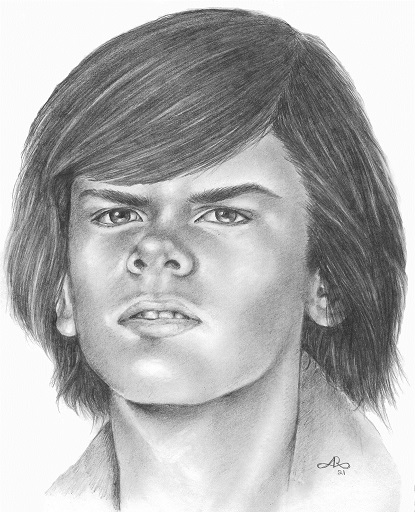
Sketch of Stacey Werder by Annie Ramsey. Created based on Stacey’s Navy photo and a photo of him with longer hair. This is what we think he probably looked like while he was in Williston in 1981.
A month after Barb went missing, another person of interest also took his own life while in jail.
Frank Delapeña
Frank Delapeña was working in Williston at the time of Barb’s disappearance, and within weeks, he had what seems like a mental breakdown. He was hospitalized in Williston on May 1st and released on the 2nd. While there, he saw a psychiatrist and underwent observation. He lost his job working for Sefel on a local seismology crew.
Delapeña stayed on at the Williston KOA in his travel trailer for a few more days, and on May 5th, he hooked it up to his white 1973 Ford van and headed for Rawlins, Wyoming.
On May 7th, traveling from Riverton to Rawlins, Delapeña started what seemed like a desperate mission to lure young women, girls, and even a little boy into his trailer along the way. He would tell them he needed to re-home a husky puppy, and they had to come inside to help him find it. He failed to lure anyone numerous times before reaching Rawlins.
Unfortunately, he was successful in Rawlins.
At 7 pm on May 7th, in broad daylight, at a busy intersection, he abducted 2 young girls, aged 9 and 12, one block away from the police station. Their bodies were found the following morning off an interstate exit, 54 miles east of Rawlins.
Because Delapeña had tried so many times in so many towns, it didn’t take long to find out who he was.
Witnesses described Frank Delapeña as Hispanic and said he spoke with a strong accent. He had curly black hair, a round face, and a dark complexion.
On May 7th, he was wearing a shirt that pictured girls kneeling on the front, a John Lennon pin, a snap-brim hat, a matching black jacket, and pants. He was pretty conspicuous with his white van pulling a 24.5ft double axel Kit Companion travel trailer and trying to give away a puppy he couldn’t find.
His van was registered to him in Williston. His travel trailer was registered to him in Utah. After the abduction, he switched the plates on the van and the trailer.
On May 9th, he parked the trailer at a KOA in Garden City, Kansas, and stayed there 4 or 5 nights before heading back towards Colorado.
Wyoming police called Williston to inquire about Delapeña, only a few weeks after Barb disappeared.
Frank Delapeña was arrested on May 12th, 1981, in Limon, Colorado, after applying for a job on a seismology crew with the same company, Sefel Geophysical, for whom he worked in Williston.
Frank urged the foreman to call his old boss, and when he did, he was told to get rid of Delapeña and call back. He sent Delapeña to get some dinner and told him to return afterward.
The Foreman was informed that Delapeña was wanted for the Rawlins murders and that he needed to contact law enforcement. The foreman assisted officers in the arrest by setting up a plan where he would have Delapeña ride with him to pick up some permits, and he would be pulled over in what seemed like a routine traffic stop. The arrest was uneventful. Delapeña did not resist.
While in the Lincoln County Jail in Hugo, Colorado, awaiting extradition to Wyoming, Delapeña didn’t eat for almost a week. A jailer claimed that Delapeña said he didn’t deserve to eat after what he had done. His captors described him as quiet and very polite, always answering with “yes, sir” and similar courtesies.
Then one day, he just started eating. He refused to sign extradition papers and wrote a long and grandiose suicide letter for the media, claiming that he was set up and that he was completely innocent. On May 22nd 1981, Frank Delapeña hung himself in his jail cell.
If the testimony of numerous witnesses from different towns along his route alone weren’t enough to prove he was responsible for those murders. The eye-witness account from one of the victim’s brothers, who saw Delapeña talking to the girls outside of his trailer just before they disappeared, paired with the physical evidence collected, far surpassed what was necessary to seal his fate.
Wyoming law enforcement executed their investigation thoroughly, and the Cheyenne Crime Lab handled the evidence meticulously. There was no doubt that Frank Delapeña killed those innocent girls. They were going to make damn sure that he didn’t get away with it.
What we know about Frank Delapena:
Francisco Javier De La Peña Chavez was born in Juárez, Chihuahua, Mexico, on July 24th, 1951. Apparently, his father was Francisco Javier De La Peña Sr. His mother’s name was Amalia Chavez Davila.
It is unknown exactly when Delapeña entered the United States, but in 1979, he was in Star Valley, Wyoming, working in seismology. He had a couple of friends who got married there, and he was the best man at their wedding.
In talking with one of them, I learned that Delapeña was married. His wife’s name was Consuelo, and he had a son named Frank Jr., who was born around 1978. The family had even come to visit in Wyoming for a few months.
According to his friend. Frank had relayed that he had a terrible childhood in Juárez and that he definitely had anger issues.
The third person of interest is someone whom I have been dragging my feet on writing about. However, I know that I have to say something.
This person, being a person of interest, is a sensitive subject with members of the family.
The experiences some describe are the opposite of what others experienced with him, and the opinions about the possibility of his involvement follow suit.
Frank Cotton
Frank Cotton was the 2nd born of the 8 surviving children. He was about 32 years old in 1981 and lived in Williston when his sister Barb disappeared. He stayed at Louise’s house periodically throughout the years and dropped in frequently when he wasn’t staying there.
Williston police have Frank listed as a person of interest. After James’ interview with Williston PD, it came across that he was a person of interest before the current investigators took over the case.
I am not sure whether every family member is aware of the reasons for Frank being on the list. This could be a major factor in why the opinions seem to differ so much. I also do not claim to know all of the reasons he made the list. Williston investigators may have additional reasons that are unknown to the public that I’m not aware of.
As with most cases where there is an “ongoing investigation”, there are usually key details that are kept from the public in hopes of securing a conviction or verifying information. Information is often kept from the public to protect witnesses and victims etc. in addition to protecting the integrity of any investigation.
The same is true for Barb’s case. Frank passed away in 1999; however, that doesn’t mean there isn’t someone out there who can prove that he was or was not involved.
Some people don’t want to discuss Frank or the experiences they had involving him that have caused them emotional distress over the years. That’s completely understandable.
However, there is one person who has agreed to have her story shared. She hopes that others, who may have had similar experiences with Frank, might have the courage to speak out about it. Her mother told her story to James in episode 17 of the podcast.
I feel compelled to mention that if Frank was actually involved in Barb’s disappearance, people sharing their stories could help solve this case. If he wasn’t involved, stories could also help exonerate him.
I can’t tell Barb’s story without including a common suspicion involving Frank. This is another sensitive topic that receives opinions from both ends of the spectrum. The common question is if Frank was involved, did Louise know of or suspect Frank’s involvement?
Obviously, I don’t know the answer to that being that I don’t know that Frank was involved.
When exploring possible theories about Louise, I obviously walked through them as if
Frank was involved. There are a few scenarios where Louise would have had knowledge or a suspicion of Frank’s involvement.
One scenario is that Louise suspected Frank. I have heard others’ opinions that Louise favored Frank and that she wouldn’t have turned him in if he was involved. A similar scenario is that Louise actually knew he was involved and, in fact, covered for him.
The other scenario is that if Frank was involved, Louise didn’t know until much later. It’s still possible she had suspicions; maybe she had no idea at all until Frank was dying.
To some, they noticed a change in Louise around the time Frank got sick and passed away. Obviously, losing a child is traumatic and undoubtedly changes most people.
However, Frank was not the first of Louise’s children to pass away after Barb disappeared. One of Louise’s sons passed away in 1993 and this perceived change involved Louise’s search for Barb and seemed to coincide with Frank’s illness and passing according to some people.
They recalled that Louise had been consistently looking for Barb ever since she disappeared and always held out hope that she would come home someday.
However, when Frank got sick they believe that Louise pretty much gave up the search and seemed to accept that Barb wasn’t coming home.
There are some facts that seem to support this idea. Something that comes to mind immediately when this is discussed is the double headstone Louise placed for Frank and Barb to share. Louise legally declared Barb deceased in 1998 which some believe would have been about the time Frank started needing his mother’s assistance with caring for himself.
I’m not someone who makes assumptions often, and I would never hang my hat on anything I can’t verify as being true. When it comes to a case that has gone unsolved for 4 and a half decades, I am willing to explore all possibilities, regardless of how unlikely others may find them.
Until something solid clearly points to a particular suspect, I see no reason to stop brainstorming on all of the endless possibilities.
I get asked what I think happened to Barb or who I think is responsible a lot.
The answer is that I have absolutely no idea.
One of the persons of interest mentioned could be responsible, someone Barb knew who was never on the radar or it could have been a complete stranger. While statistically stranger abductions are not very common, at the height of the oil boom in Williston there were so many men pouring into town in search of work etc. (Frank Delapeña for example) that it would be ignorant to pretend that the odds of it happening didn’t increase proportionately.
There’s also things that I can’t discuss that lead me to think that certain persons of interest are probably more likely to be responsible than others but, I still don’t know what happened or who was responsible with any degree of certainly.
There is no shortage of rabbit holes in this case, and no way to know if the correct one has even been found yet.
At the very least, none of them have produced a rabbit!
The most detailed account of this long and confusing case is James Wolner’s podcast Dakota Spotlight.
Barb is featured in the 5th season “A Better Search for Barbara Cotton”. We can’t thank him enough for all of the time and effort he has put into Barb’s case. No doubt, this page wouldn’t be here today if it wasn’t for him.
Dakota Spotlight: A Better Search for Barbara Cotton